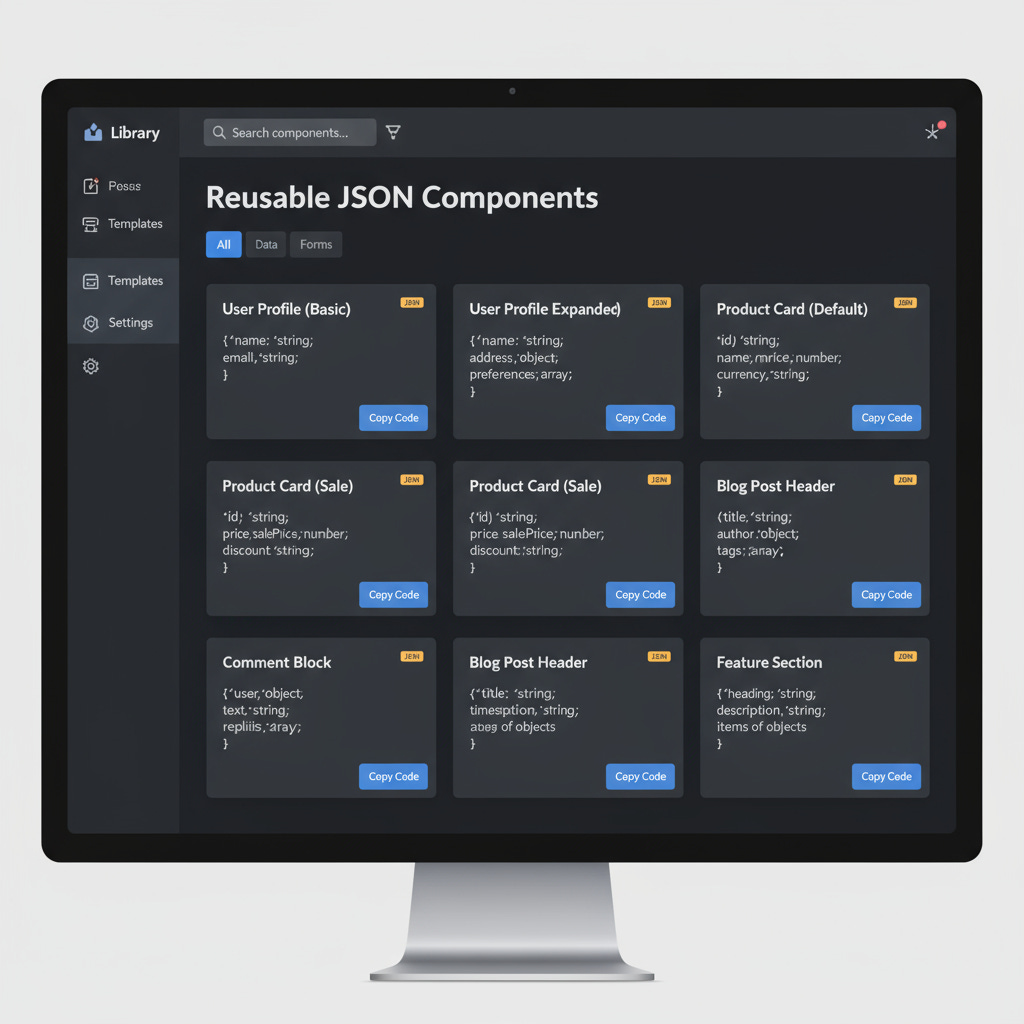
Chain Templates
The Multiplier Effect: One Template, Infinite Variations


Sequential Execution
Sync not async
For tightly coupled creation pipelines, each step depends on artifacts from the prior step, making synchronous execution the most deterministic way to guarantee correct ordering and data handoff.
This favors clarity over speculative parallelism for short, compositional steps, aligning with patterns where node outputs are explicitly wired into downstream operations.
Step referencing and AI‑generated bulk calls
A simple placeholder convention passes state downstream—for example, “$step:1.nodeID” or “$step3.styleID” indicate that a later step consumes identifiers created by earlier steps. The entire bulk prompt can be AI‑generated from a plain instruction like “make bulk call for card with icon, title, paragraph,” which expands into an ordered chain with explicit inputs and outputs.
Template Reusability
Bulk templating
Bulk templating turns chains of operations into reusable, parameterized JSON templates that produce rapid variations with minimal overhead in both time and tokens.
This mirrors mature automation ecosystems where a graph captures the full workflow so variations require only input changes rather than re‑authoring every step.
Technical Deep-Dive
Retry logic baked into the schema
Embedding retry and cleanup policies into the bulk schema lets the system handle partial failures, rollbacks, and progressive refinement without manual oversight.
Treating the chain as a single unit for error propagation and cancellation prevents leaks and ensures predictable recovery paths.
Progressive chaining strategy
The AI composes a short, minimal chain first—say three steps—verifies it runs cleanly, and then incrementally adds steps until the full sequence (for example, thirteen steps) succeeds.
Staged expansion reduces blast radius, shortens feedback loops, and increases the success rate for complex runs while preserving an auditable lineage of step outputs.
Simplified bulk call example
Below is a minimal two‑step example showing a root frame followed by a layout pass that references the prior step’s nodeID via a placeholder, illustrating synchronous handoff and explicit state wiring.
{
  “commands”: [
    {
      “tool”: “shape”,
      “params”: {
        “shape”: {
          “type”: “frame”,
          “name”: “feature-card”,
          “config”: { “x”: 100, “y”: 100, “width”: 640, “height”: 360 },
          “fill”: {
            “kind”: “direct_paint”,
            “paint”: [{ “type”: “SOLID”, “color”: { “r”: 0.95, “g”: 0.95, “b”: 0.95 } }]
          }
        }
      }
    },
    {
      “tool”: “auto_layout”,
      “params”: {
        “layout”: {
          “nodeId”: “$step:0.nodeID”,
          “layoutMode”: “HORIZONTAL”,
          “itemSpacing”: 16,
          “paddingTop”: 16,
          “paddingRight”: 16,
          “paddingBottom”: 16,
          “paddingLeft”: 16
        }
      }
    }
  ]
}
Why This Matters for the Future
Reusable chains compound gains
Once a chain runs cleanly, saving it as a template compounds value: reproducibility, faster iteration, and lower cognitive load when generating numerous variants with stable quality.
Teams benefit from consistent results and reduced token and time budgets across repeated executions.
Agentic creation across domains
Bulk templating generalizes beyond design to music, 3D, architecture, and interiors—any multi‑tool flow where structure stays fixed while expressive parameters vary across iterations.
Templates lock in the dependable steps and expose the creative dials, enabling fast, high‑quality variation at scale.
Portability and reliability
Standardized interfaces between assistants, tools, and data sources pair naturally with bulk templates: typed inputs and outputs make chained steps composable and debuggable.
Open, shared contracts reduce integration friction so a single template pattern can be reused across diverse services without bespoke adapters.
Shareable templates, shared progress
A public ecosystem of reusable chains lets creators publish proven templates as drop‑ins that others can adapt to brand, style, or constraints within minutes.
Community templates compress setup time and make best practices discoverable, bootstrapping complex automations with minimal configuration.